


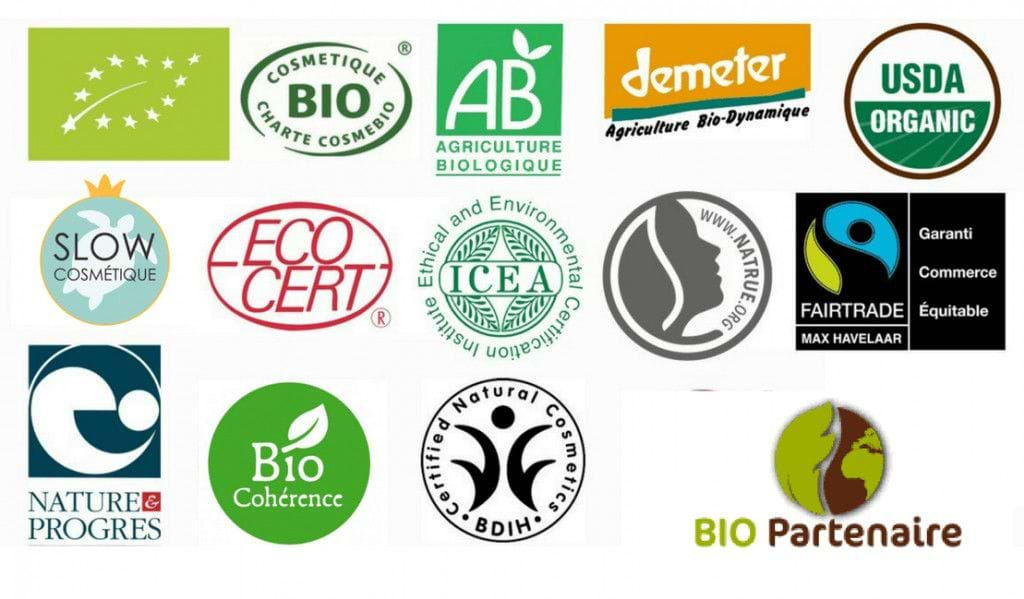
Better for both our health and the planet, organic products are experiencing tremendous growth. As a mark of quality, they are now widely available in supermarkets — which can sometimes make choosing more difficult. For responsible and informed consumption, a clear understanding of organic labels is crucial. Let’s review the different organic certifications and identify the most trustworthy ones.
Before anything else, it is important to understand what an organic product is. Concretely, it is an agricultural product or food item that comes from organic farming. Its production must comply with European regulations, including:
- Strict prohibition of GMOs and synthetic chemical products (fertilizers, herbicides, etc.)
- Respect for animal welfare
- At least 95% of ingredients from organic farming in processed products
If these conditions are met, products can receive organic certification. Organic labels help identify these products and guarantee their quality and compliance with strict standards.
Note that organic farming regulations do not apply to non-agricultural or non-food products, such as cosmetics, textiles, or other non-food processed goods. However, these products may still use the term “organic” if there is a direct link to certified organic ingredients.
Organic Labels: Product Control and Certification
Before being marketed under an organic label, products undergo inspection and certification. In France, an independent organization approved and accredited by public authorities handles this process. Examples include Qualité France, Ecocert, Certipaq, and Agrocert.
Other organizations also oversee organic production, such as the French Agency for the Development and Promotion of Organic Agriculture (Agence BIO) and the DGCCRF (Directorate-General for Competition, Consumer Affairs and Fraud Control).
The Role of Agence BIO
Created in 2001, Agence BIO is a national information and action platform that promotes and supports the development of organic farming in France. All stakeholders in the organic sector (producers, importers, wholesalers, retailers, etc.) must declare their activity to this organization, which manages notifications from certified operators.
The Role of the DGCCRF
As part of its mission to protect consumers and monitor markets, the DGCCRF verifies that operators comply with European organic regulations, including:
- Mandatory certification of activities
- Accuracy of claims displayed on products
- Absence of pesticide residues in organic products
These inspections are generally scheduled annually but may also occur following complaints or detected non-compliance.
In addition, certification bodies approved by INAO (French National Institute of Origin and Quality) conduct systematic inspections of operators at least once per year.
The Different Certified Organic Labels
Today, there are many organic labels in France. Without understanding their guarantees, identifying the most reliable ones can be challenging. Here is a clearer overview to help you choose wisely.
Organic Labels for Food Products
AB and Bio Europe
Created in 1985, the French AB label is the official national certification. Since 2010, it complies with the same standards as the European organic regulation:
- No synthetic pesticides or chemical treatments
- GMO presence limited to 0.9% in cases of accidental contamination
- Mixed organic and non-organic production allowed under strict conditions
Certified products must display the European organic leaf logo (Euroleaf) on packaging. The AB logo is optional.
Bio Cohérence
Created in response to European regulatory changes, Bio Cohérence applies stricter standards than the EU regulation. Farms must be either fully organic or fully in conversion — mixing systems is prohibited.
Additional requirements include:
- Entire production process carried out in France
- At least 50% of animal feed sourced from the farm (80% for herbivores)
- GMOs strictly prohibited
- Processed products must contain 100% organic ingredients
Animal welfare standards are also reinforced, with limited veterinary treatments and transport time restricted to 8 hours maximum.
Demeter
Based on biodynamic agriculture principles, Demeter is a private organic label with strict criteria:
- Complete prohibition of GMOs and synthetic chemicals
- Animal feed: two-thirds must be Demeter-certified, with 80% produced on the farm
- Crop rotation and green manure practices required
- Processed products must contain at least 90% Demeter-certified ingredients
Producers must apply all biodynamic techniques to qualify.
Bio Partenaire
Created in 2015, Bio Partenaire is a private label combining organic certification with fair trade principles. It guarantees:
- Compliance with EU organic regulations
- Contracts ensuring fair prices and purchase volumes for at least 3 years
- Support for local production
- Fair remuneration for producers
- Environmentally responsible production methods
Unlike some other labels, Bio Partenaire products are mainly found in specialized organic stores.
Nature & Progrès
One of the oldest organic organizations in France and Europe, Nature & Progrès has standards exceeding European criteria:
- 100% organic ingredients
- GMOs and palm oil prohibited
- At least 50% plant-based fertilizers
- Animals fed exclusively organic feed
- Animal transport limited to 6 hours
Inspections occur twice per year by association members.
FairTrade / Max Havelaar
Primarily certifying small producers, this private label promotes fair trade. However, products are not necessarily organic unless they also display the AB or EU organic logo.
It ensures economic, social, and environmental criteria adapted to each sector and country.
Organic Labels for Cosmetic Products
Organic certification also exists for beauty and personal care products.
Ecocert
Created in 1991, Ecocert is both a certification body and cosmetic label. Requirements include: Environmentally respectful manufacturing processes At least 95% natural or naturally derived ingredients No synthetic fragrances, colorants, or silicones No animal testing on finished products No animal-derived raw materials
A minimum percentage of ingredients must also meet fair trade standards.
Cosmébio
Founded in 2002, Cosmébio is a leading French organic cosmetics label requiring:
- At least 95% natural ingredients
- At least 95% organic plant ingredients
- Minimum 10% organic ingredients in the final product
- No nanoparticles, GMOs, or animal-derived ingredients
- No animal testing
It also follows an ethical charter.
Natrue
The European Natrue label fights greenwashing and certifies natural and organic cosmetics at three levels:
- Natural cosmetics
- Natural cosmetics with organic portion
- Organic cosmetics
Each level sets minimum and maximum percentages of natural and organic ingredients.
BDIH
This German label requires:
- Preferential use of organic plant ingredients
- No GMOs, mineral oils, silicones, or synthetic colorants/fragrances
- No animal testing
- Strict control of synthetic preservatives
- All ingredients must appear on an approved positive list.
Organic Awards Selected by Consumer Jury
In addition to certifications, distinctions such as “Meilleur Produit Bio” (Best Organic Product) recognize excellence in organic products sold in specialized stores. A jury of at least 100 consumers selects winners, helping guide shoppers toward trusted organic choices.
In short, we hope this guide helps you see more clearly among all these organic labels!
